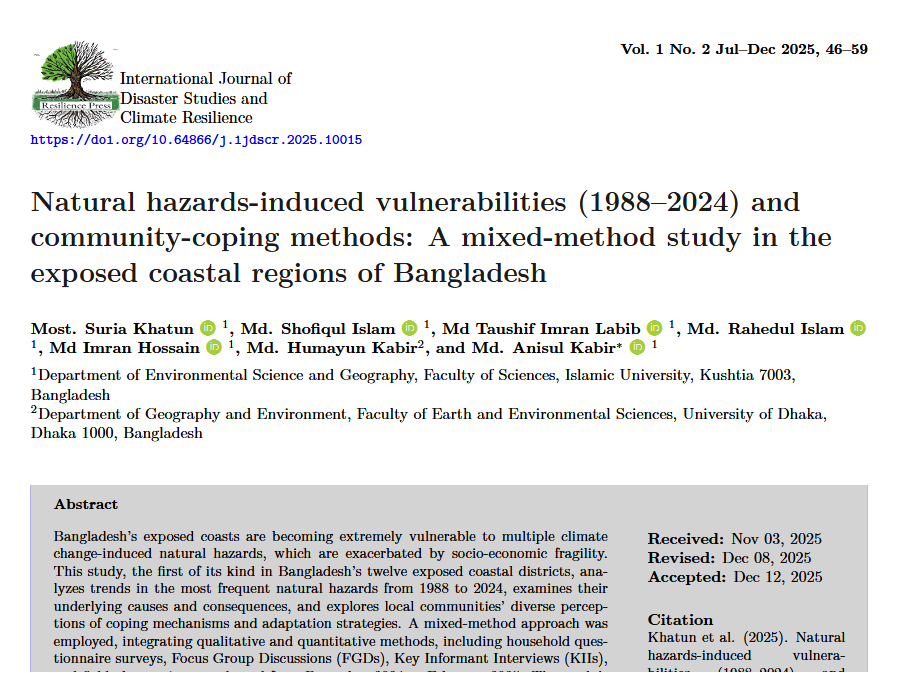
Natural hazards-induced vulnerabilities (1988–2024) and community-coping methods: A mixed-method study in the exposed coastal regions of Bangladesh
DOI:
https://doi.org/10.64866/j.ijdscr.2025.10015Keywords:
Exposed coastal regions, Multi-hazard vulnerability, Community coping strategies, Climate change adaptation, Coastal hazard resilienceAbstract
Bangladesh’s exposed coasts are becoming extremely vulnerable to multiple climate change-induced natural hazards, which are exacerbated by socio-economic fragility. This study analyzes the trends of the most frequent natural hazards (1988–2024), along with underlying causes and consequences, exploring the local community’s diverse perceptions regarding coping mechanisms and adaptation strategies in Bangladesh’s twelve exposed coastal districts. A mixed-method approach was employed, integrating qualitative and quantitative methods, including household questionnaire surveys, focus group discussions, key informant interviews, and field observations conducted from December 2024 to February 2025. The study’s findings reveal that synergistically, environmental, physical, as well as socio-economic factors influence coastal multi-hazard vulnerability. Lack of awareness, limited institutional capacity, poor infrastructure, and fragile housing significantly aggravate these risks. Disaster-related mortality and injury ratios are higher among disproportionately affected children, women, and the elderly, compared to men. Major consequences include disease outbreaks like diarrhea and cholera, severe livelihood losses accounting for 108.5 million, and extensive environmental degradation in fisheries, agriculture, and mangrove ecosystems. In response, coastal communities have adopted several coping strategies, including community-based early warning systems, livelihood diversification, mangrove plantation, and cultivation of specific salt-tolerant rice varieties. Improving early warning systems, upgrading infrastructure, promoting sustainable livelihood practices, and expanding community training are all crucial to strengthening resilience throughout coastal Bangladesh. A lack of long-term recovery planning and inadequate policy implementation limit such resilience. This study will provide policymakers of relevant ministries with critical insights for ecosystem-based, gender-sensitive, and integrated coastal management policies to enhance the community’s adaptive capability and resilience.
Downloads
References
Ahmed, M.N.Q., Atiqul Haq, S.M., 2019. Indigenous people’s perceptions about climate change, forest resource management, and coping strategies: a comparative study in Bangladesh. Environment, Development and Sustainability 21, 679–708. https://doi.org/10.1007/s10668-017-0055-1.
Al-Mueed, M., Chawdhery, M.R.A., Harera, E., Alhazmi, R.A., Mobrad, A.M., Althunayyan, S.M., Al-Wathinani, A.M., 2021. Potential of community volunteers in flood early warning dissemination: A case study of Bangladesh. Int. J. Environmental Research and Public Health 18, 13010. https://doi.org/10.3390/ijerph182413010.
Alam, A., Miller, F., 2019. Slow, small and shared voluntary relocations: Learning from the experience of migrants living on the urban fringes of khulna, Bangladesh. Asia Pacific Viewpoint 60, 325–338. https://doi.org/10.1111/apv.12244.
Ali, A., 2000. Vulnerability of Bangladesh coastal region to climate change with adaptation options. Bangladesh Space Research and Remote Sensing Organization (SPARRSO), Dhaka.
Apparao, G., Mallikarjunareddy, P., Raju, S.G., 2013. Identification of accident black spots for the national highway using gis. Int. J. of Scientific & Technology Research 2, 154–157.
Ashrafuzzaman, M., 2023. Local context of climate change adaptation in the south-western coastal region of Bangladesh. Sustainability 15, 6664. https://doi.org/10.3390/su15086664.
Cell, C.C., 2007. Climate Change and Bangladesh. Department of Environment, Government of the People’s Republic of Bangladesh.
Chowdhury, K.J., Ali, M.R., Chowdhury, M.A., Islam, S.L.U., 2025. Climate change-induced risks assessment of a coastal area: A “socioeconomic and livelihood vulnerability index” based study in coastal Bangladesh. Natural Hazards Research 5, 75–87. https://doi.org/10.1016/j.nhres.2024.06.005.
Chumky, T., Basu, M., Onitsuka, K., Raihan, M.L., Hoshino, S., 2023. How do left-behind families adapt to the salinity induced male out-migration context? a case study of Shyamnagar sub-district in coastal Bangladesh. Sustainability 15, 2756. https://doi.org/10.3390/su15032756.
Eckstein, D., Hutfils, M.L., Winges, M., 2018. Global climate risk index 2019: Who suffers most from extreme weather events. URL: http://www.germanwatch.org/en/cri.
Fatema, S.R., Islam, M.S., East, L., Usher, K., 2019. Women’s health-related vulnerabilities in natural disasters: a systematic review protocol. BMJ Open 9, 032079. https://doi.org/10.1136/bmjopen-2019-032079.
Fatouros, S., Capetola, T., 2021. Examining gendered expectations on women’s vulnerability to natural hazards in low to middle income countries: A critical literature review. Int. J. Disaster Risk Reduction 64, 102495. https://doi.org/10.1016/j.ijdrr.2021.102495.
Guha-Sapir, D., Hargitt, D., Hoyois, P., 2004. Thirty Years of Natural Disasters 1974–2003: The Numbers. Presses Univ. de Louvain.
Haque, Z., Ruben, J., Swarna, K., 2022. Bangladesh: Enhancing Coastal Resilience in a Changing Climate. Washington, D.C.: World Bank. URL: http://documents.worldbank.org/curated/en/099552209012279085.
Hossen, M.A., Chowdhury, Md A., Hans, A., Tagoe, C.A., Allan, A., Nelson, W., Patel, A., Mondal, M.S., Salehin, M., Quaye, R.M., Das, S., 2019. Governance challenges in addressing climatic concerns in coastal asia and africa. Sustainability 11, 2148. https://doi.org/10.3390/su11072148.
Hussain, M., Hoq, M.E., 2008. Impacts of climate change on coastal and marine fisheries resources in Bangladesh. Bay of Bengal News Sept.--Dec. 2008.
Islam, M.R., Hossain, D., 2014. Island char resources mobilization (ICRM): changes of livelihoods of vulnerable people in Bangladesh. Social Indicators Research 117, 1033–1054. https://doi.org/10.1007/s11205-013-0375-y.
Islam, M.T., Nursey-Bray, M., 2017. Adaptation to climate change in agriculture in Bangladesh: The role of formal institutions. J. Env. Mgt 200, 347–358. https://doi.org/10.1016/j.jenvman.2017.05.092.
Khan, M.S.H., Parkash, B., Kumar, S., 2005. Soil–landform development of a part of the fold belt along the eastern coast of Bangladesh. Geomorphology 71, 310–327. https://doi.org/10.1016/j.geomorph.2005.03.003.
Mallick, B., Vogt, J., 2014. Population displacement after cyclone and its consequences: empirical evidence from coastal Bangladesh. Natural Hazards 73, 191–212. https://doi.org/10.1007/s11069-013-0803-y.
Md, A., Gomes, C., Dias, J.M., Cerda, A., 2022. Exploring gender and climate change nexus, and empowering women in the south western coastal region of Bangladesh for adaptation and mitigation. Climate 10, 172. https://doi.org/10.3390/cli10110172.
Mirza, S., 2000. Incidental findings on magnetic resonance imaging screening for cerebellopontine angle tumours. J. Laryngology & Otology 114, 750–754. https://doi.org/10.1258/0022215001904077.
MoEFCC, 2022.National Adaptation Plan of Bangladesh (2023-2050). Ministry of Environment, Forest and Climate Change,Bangladesh, 264p
Parvin, G.A., Takahashi, F., Shaw, R., 2008. Coastal hazards and community-coping methods in Bangladesh. Journal of Coastal Conservation 12, 181–193. https://doi.org/10.1007/s11852-009-0044-0.
Quader, M.A., Khan, A.U., Kervyn, M., 2017. Assessing risks from cyclones for human lives and livelihoods in the coastal region of Bangladesh. Int. J. Environmental Research and Public Health 14, 831. https://doi.org/10.3390/ijerph14080831.
Rahman, A., 2009. Policy study on the probable impacts of climate change on poverty and economic growth and the options of coping with adverse effect of climate change in Bangladesh. Dhaka: General Economics Division, Planning Commission, Government of the People’s Republic of Bangladesh & UNDP Bangladesh.
Rahman, M.M., 2024. Assessing the climate induced livelihood vulnerability of coastal people using sustainable livelihood framework: A study in south-central Bangladesh. Social Sciences 13, 638. https://doi.org/10.3390/socsci13120638.
Rakib, M.A., Sasaki, J., Matsuda, H., Fukunaga, M., 2019. Severe salinity contamination in drinking water and associated human health hazards increase migration risk in the southwestern coastal part of Bangladesh. J. Env. Mgt 240, 238–248. https://doi.org/10.1016/j.jenvman.2019.03.101.
Roy, T., 2018. Disaster Risk Reduction Interventions in Bangladesh: a Case Study on Selected Villages of Southwest Region. Doctoral dissertation, University of Dhaka.
Saddam, M.M.H., Hossain, K.T., Mollick, P., 2025. Shoreline dynamics in response to sea-level changes on the eastern coast of Bangladesh. Environmental Monitoring and Assessment 197, 1–17. https://doi.org/10.1007/s10661-025-14375-x.
Saha, C.K., 2015. Dynamics of disaster-induced risk in southwestern coastal Bangladesh: an analysis on tropical cyclone Aila 2009. Natural Hazards 75, 727–754. https://doi.org/10.1007/s11069-014-1343-9.
Sarker, S., Hossain, S., Islam, M.A., 2023. Climate change tempted disaster instigated human migration in the coastal districts of Bangladesh. J. Agroforestry and Environment 16, 54–62. https://doi.org/10.55706/jae.
Singh, O.P., 2002. Predictability of sea level in the Meghna estuary of Bangladesh. Global and Planetary Change 32, 245–251. https://doi.org/10.1016/S0921-8181(01)00152-7.
Uddin, M.M., Al-Amin, M., Akter, S., 2022. Exploring Bangladesh disaster management’s institutional and policy challenges: A critical review. Indiana Journal of Economics and Business Management 2, 11–19. https://doi.org/10.5281/zenodo.7267722.
UN Women, 2022. State Of Gender Equality And Climate Change In Bangladesh. United Nations Women. Available at: https://asiapacific.unwomen.org/sites/default/files/2022-08/State-of-Gender-Equality-and-Climate-Change-in-Bangladesh.pdf.
Uzzaman, M.A., 2014. Impact of sea level rise in the coastal areas of Bangladesh: A macroeconomic analysis. J. Economics and Sustainable Development 5, 105–109.
World Bank, 2000. Bangladesh. Climate Change & Sustainable Development (Report No. 21104 BD). Washington, DC: World Bank. http://dx.doi.org/https://doi.org/10.1596/15706
World Bank, 2024. Climate Risk Country Profile: Bangladesh. Washington, DC: World Bank.
World Health Organization, 2024. COP29 special report on climate change and health: Health is the argument for climate action. Geneva: WHO. Available at: https://cdn.who.int/media/docs/default-source/environment-climate-change-and-health/58595-who-cop29-special-report_layout_9web.pdf
Downloads
Published
Issue
Section
License
Copyright (c) 2025 Most. Suria Khatun, Md. Shofiqul Islam, Md Taushif Imran Labib , Md. Rahedul Islam , Md Imran Hossain , Md. Humayun Kabir, Md. Anisul Kabir (Author)

This work is licensed under a Creative Commons Attribution-ShareAlike 4.0 International License.
How to Cite