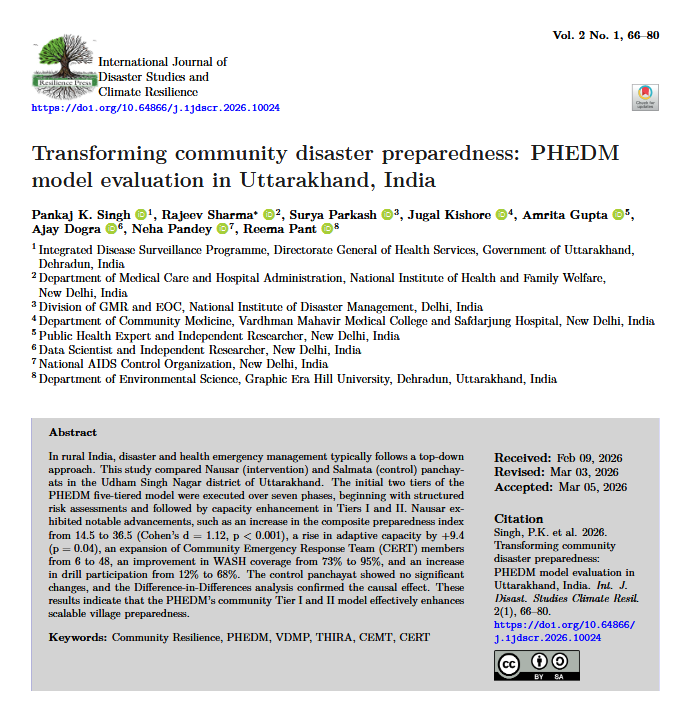
Transforming community disaster preparedness: PHEDM model evaluation in Uttarakhand, India
DOI:
https://doi.org/10.64866/j.ijdscr.2026.10024Keywords:
Community Resilience, PHEDM, VDMP, THIRA, CEMT, CERTAbstract
In rural India, disaster and health emergency management typically follows a top-down approach. This study compared Nausar (intervention) and Salmata (control) panchayats in the Udham Singh Nagar district of Uttarakhand. The initial two tiers of the PHEDM five-tiered model were executed over seven phases, beginning with structured risk assessments and followed by capacity enhancement in Tiers I and II. Nausar exhibited notable advancements, such as an increase in the composite preparedness index from 14.5 to 36.5 (Cohen’s d = 1.12, p < 0.001), a rise in adaptive capacity by +9.4 (p = 0.04), an expansion of Community Emergency Response Team (CERT) members from 6 to 48, an improvement in WASH coverage from 73% to 95%, and an increase in drill participation from 12% to 68%. The control panchayat showed no significant changes, and the Difference-in-Differences analysis confirmed the causal effect. These results indicate that the PHEDM’s community Tier I and II model effectively enhances scalable village preparedness.
Downloads
References
Adams, N.E., 2015. Bloom’s taxonomy of cognitive learning objectives. Journal of the Medical Library Association: JMLA 103, 152–153.
Asian Disaster Preparedness Center; Government of India UNDP Disaster Risk Management Programme (ADPC) 2009. Evaluation and review of lessons learnt. United Nations Development Programme 2009. https://www.undp.org/india/publications/government-india-undp-disaster-risk-management-programme-2002-2009-evaluation-and-review-lessons. accessed March 3, 2026.
Community Planning Toolkit, 2014. Community Engagement And Community Places, 2014. https://www.communitycommons.org/entities/c99aece3-4159-4fd1-a504-2155d69f3605. accessed March 3, 2026.
COP28 UAE Declaration, 2023. COP28 UAE Declaration On Climate And Health. https://www.cop28.com/en/cop28-uae-declaration-on-climate-and-health. accessed March 3, 2026.
Dasgupta, S., Badola, R., 2020. Indicator-based assessment of resilience and vulnerability in the Indian Himalayan Region: A case study on socio-economy under different scenarios. Sustainability 12, 6938. https://doi.org/10.3390/su12176938.
FEMA, 2018. Threat And Hazard Identification And Risk Assessment (THIRA) and Stakeholder Preparedness Review (SPR) Guide: Comprehensive Preparedness Guide (CPG) 201. 3rd ed. https://www.fema.gov/sites/default/files/2020-04/CPG201Final20180525.pdf. accessed March 3, 2026.
Gertler et al., 2016. Matching methods, in: Gertler, P.J., Martinez, S., Premand, P., Rawlings, L.B., Vermeersch, C.M.J. (Eds.), Impact Evaluation in Practice. 2nd ed.. World Bank, Washington, DC. https://openknowledge.worldbank.org/handle/10986/25030.
Government of Uttarakhand, 2017. Uttarakhand Disaster Recovery Project—Additional Financing: The World Bank Assisted Environment And Social Management Framework. https://documents.worldbank.org/curated/en/322511512560617379/pdf/SFG3819-EA-P164058-Box405315B-PUBLIC-Disclosed-12-6-2017.pdf. accessed March 3, 2026.
ICMR, 2017. National Ethical Guidelines For Biomedical And Health Research Involving Human Participants. https://ethics.ncdirindia.org/asset/pdf/ICMR_National_Ethical_Guidelines.pdf. accessed March 3, 2026.
IFRCRCS, 1999. International Federation Of Red Cross And Red Crescent Societies. Vulnerability And Capacity Assessment Guide. https://preparecenter.org/wp-content/uploads/2022/05/VCA-guide-ifRC.pdf. accessed March 3, 2026.
Indian Public Health Standards (IPHS), 2022. https://nhsrcindia.org/IPHS2022. Ministry of Health and Family Welfare, Government of India. Accessed March 3, 2026.
IPCC, 2022. Climate Change 2022: Impacts, Adaptation and Vulnerability. Contribution of Working Group II to the Sixth Assessment Report of the Intergovernmental Panel on Climate Change. https://www.ipcc.ch/report/ar6/wg2/. accessed March 3, 2026.
Joseph, J.K., Anand, D., Prajeesh, P., Zacharias, A., Varghese, A.G., Pradeepkumar, A.P., Baiju, K.R., 2020. Community resilience mechanism in an unexpected extreme weather event: An analysis of the Kerala floods of 2018, India. Int J Disaster Risk Reduct 40, 101741. https://doi.org/10.1016/j.ijdrr.2020.101741.
Maikhuri, R.K. et al., 2017. Socio-ecological vulnerability: Assessment and coping strategy to environmental disaster in Kedarnath valley, Uttarakhand, Indian Himalayan region. Int J Disaster Risk Reduct 25, 111–124. https://doi.org/10.1016/j.ijdrr.2017.09.002.
Ministry of Panchayati Raj, 2026. Government Of India. Egramswaraj Portal: Basic Statistics Of Panchayati Raj Institutions (PRIs). https://panchayat.gov.in/en/e-gramswaraj. accessed March 3, 2026.
National Health Policy (NHP), 2017. https://www.mohfw.gov.in/sites/default/files/9147562941489753121.pdf. Ministry of Health and Family Welfare, Government of India. Accessed March 3, 2026.
NDMA, 2014. Model Framework For District Disaster Management Plan. https://ndma.gov.in/sites/default/files/PDF/NDMA%20DDMP%20Framework.pdf. accessed March 3, 2026.
NDMA, 2019. National Disaster Management Plan. https://ndma.gov.in/sites/default/files/PDF/ndmp-2019.pdf. accessed March 3, 2026.
NITI Aayog, 2024. Future Pandemic Preparedness and Emergency Response: A Framework for Action. Technical Report. Government of India, Sept. 2024. www.niti.gov.in/sites/default/files/2024-09/Report-of-the-Exper-Group--Future-Pandemic-preparedness-and-emergency-response_0.pdf.
PIB, 2014. ‘Whole Of Government’ Approach During The COVID-19. https://www.pib.gov.in/Pressreleaseshare.aspx?PRID=2037420®=3&lang=2. accessed July 31, 2025.
Ramsbottom, A. et al., 2018. Enablers and barriers to community engagement in public health emergency preparedness: A literature review. J Community Health 43, 412–420. https://doi.org/10.1007/s10900-017-0415-7.
Sendai Framework, 2015. Sendai Framework For Disaster Risk Reduction 2015–2030. https://www.undrr.org/publication/sendai-framework-disaster-risk-reduction-2015-2030. accessed March 3, 2026.
Sharma et al., 2025. A five-tier framework for scalable public health emergency and disaster management: Enhancing pandemic and climate resilience. Disaster Dev 14, 37. https://nidm.gov.in/journal/PDF/Journal/NIDMJOURNAL_JanJun2025/NIDMJOURNAL_JanJun20252.pdf.
Singh, P.K., 2023. Building community capabilities to mitigate and respond to public health emergencies due to climate change. Indian J Forensic Community Med 10, 59. https://doi.org/10.18231/j.ijfcm.2023.010.
Sufri, S., Dwirahmadi, F., Phung, D. et al., 2020. A systematic review of community engagement (CE) in disaster early warning systems (EWSS). Prog Disaster Sci 5. https://doi.org/10.1016/j.pdisas.2019.100058.
Swinburn, B.A., Kraak VI, Azllender, S. et al., 2019. The global syndemic of obesity, undernutrition, and climate change: the Lancet Commission report. The Lancet 393, 791 846. https://doi.org/10.1016/S0140-6736(18)32822-8.
The Royal Society, 2012. People and the Planet. The Royal Society, London. https://royalsociety.org/-/media/policy/projects/people-planet/2012-04-25-peopleplanetsummary.pdf.
USDMA, 2020. Uttarakhand State Disaster Management Plan 2020 21 Volume I. https://ndma.gov.in/sites/default/files/PDF/SDMP/UK-Volume_1.pdf. accessed March 3, 2026.
Viksit Bharat, 2026. Vision Of Viksit Bharat 2047. https://viksitindia.com/. accessed March 3, 2026.
Vinodhkumar, B., Jose, A.M., Rao, K.K. et al., 2022. Future precipitation extremes over base Himalayan Uttarakhand region: Analysis using the statistically downscaled, bias-corrected high-resolution NEX-GDDP datasets. Theor Appl Climatol 149, 1239–1253. https://doi.org/10.1007/s00704-022-04111-7.
Whitmee, S., Haines, A., Beyrer, C., Boltz, F., Capon, A.G., Souza Dias, B.F., Ezeh, A., Frumkin, H., Gong, P., Head, P., Horton, R., 2015. Safeguarding human health in the anthropocene epoch: report of the Rockefeller foundation–Lancet commission on planetary health. The Lancet 386, 1973–2028. https://doi.org/10.1016/S0140-6736(15)60901-1.
WHO Climate Change, 2024. https://www.who.int/news-room/fact-sheets/detail/climate-change-and-health. accessed March 3, 2026.
WHO STAR, 2021. World Health Organization. Strategic Toolkit For Assessing Risks: A Comprehensive Toolkit For All Hazards Health Emergency Risk Assessment. https://iris.who.int/server/api/core/bitstreams/650a040f-33a4-4ef2-bb57-effd6ce95c91/content. accessed March 3, 2026.
Downloads
Published
Data Availability Statement
The datasets used and analyzed in this study were provided by the Integrated Disease Surveillance Programme, Department of Medical Health and Family Welfare, Dehradun, Government of Uttarakhand. Data is available at NIDM website
https://nidm.gov.in/pdf/trgReports/2022/July/Report_28-30July2022sp.pdf
Issue
Section
License
Copyright (c) 2026 Pankaj K. Singh, Rajeev Sharma, Surya Parkash, Jugal Kishore, Amrita Gupta, Ajay Dogra, Neha Pandey, Reema Pant (Author)

This work is licensed under a Creative Commons Attribution-ShareAlike 4.0 International License.
How to Cite