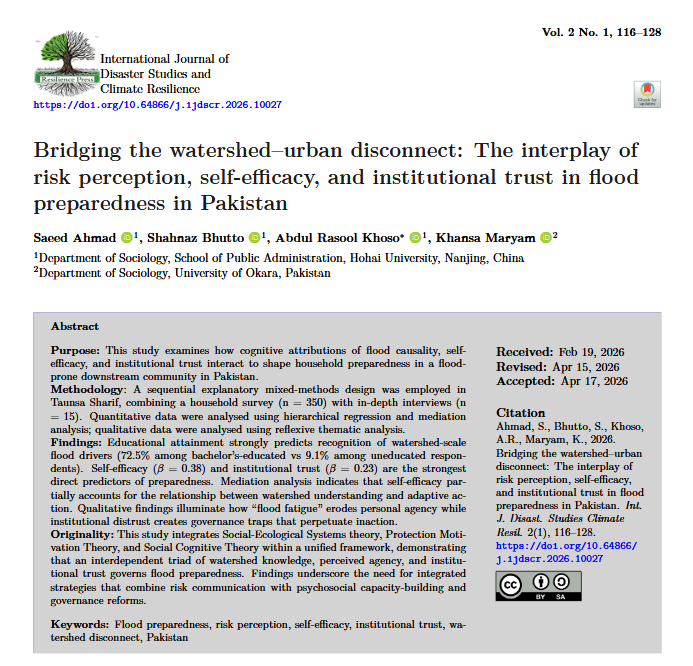
Bridging the watershed–urban disconnect: The interplay of risk perception, self-efficacy, and institutional trust in flood preparedness in Pakistan
DOI:
https://doi.org/10.64866/j.ijdscr.2026.10027Keywords:
Flood preparedness; risk perception; self-efficacy; institutional trust; watershed disconnect; PakistanAbstract
Purpose: This study examines how perceptions of flood causality, self-efficacy, and institutional trust interact to shape household preparedness in a flood-prone downstream community in Pakistan.
Methodology: A sequential explanatory mixed-methods design was employed in Taunsa Sharif, combining a household survey (n = 350) with in-depth interviews (n = 15). Quantitative data were analyzed using hierarchical regression and mediation analysis; qualitative data were examined through reflexive thematic analysis.
Findings: Educational attainment strongly predicts recognition of watershed-scale flood drivers (72.5% among bachelor's-educated vs 9.1% among uneducated respondents). Self-efficacy (β = 0.38) and institutional trust (β = 0.23) are the strongest direct predictors of preparedness. Mediation analysis indicates that self-efficacy partially accounts for the relationship between watershed understanding and adaptive action. Qualitative findings illuminate how "flood fatigue" erodes personal agency while institutional distrust creates governance traps that perpetuate inaction.
Originality: This study integrates Social-Ecological Systems theory, Protection Motivation Theory, and Social Cognitive Theory within a unified framework, demonstrating that an interdependent triad of watershed knowledge, perceived agency, and institutional trust governs flood preparedness. Findings underscore the necessity of integrated strategies combining risk communication with psychosocial capacity-building and governance reforms.
Downloads
References
Adger, W.N., Quinn, T., Lorenzoni, I., Murphy, C., 2018. The social contract for climate risks. Institutional Capacity for Climate Change Response 76, 76–89. https://doi.org/10.9774/gleaf.9781315651354_7.
Agapito, J.V.C., Rosales, R.M.L., Pascual, A.C., Concepcion, C.R., Lagmay, A.M.F.A., 2026. Counterfactual evidence on the impacts of operations research on Philippine disaster risk reduction efforts. Disaster Prevention and Management: An International Journal 35, 44–63. https://doi.org/10.1108/DPM-04-2025-0127.
Akbar, M.S., Aldrich, D.P., 2017. Determinants of post‐flood social and institutional trust among disaster victims. Journal of Contingencies and Crisis Management 25, 279–288. https://doi.org/10.1111/1468-5973.12152.
Bandura, A., 1989. Human agency in social cognitive theory. American Psychologist 44, 1175. https://doi.org/10.1037/0003-066X.44.9.1175.
Bandura, A., 2001. Social cognitive theory: An agentic perspective. Annual Review of Psychology 52, 1–26. https://doi.org/10.1146/annurev.psych.52.1.1.
Benjamin, S., Parsons, M., Apthorp, D., Lykins, A.D., 2022. Why take the risk? Exploring the psychosocial determinants of floodwater driving. Frontiers in Psychology 13, 913790. https://doi.org/10.3389/fpsyg.2022.913790.
Braun, V., Clarke, V., 2006. Using thematic analysis in psychology. Qualitative Research in Psychology 3, 77–101. https://doi.org/10.1191/1478088706qp063oa.
Bronfenbrenner, U., 1994. Ecological models of human development. International Encyclopedia of Education 3, 37–43.
Bubeck, P., Botzen, W.J.W., Aerts, J.C., 2012. A review of risk perceptions and other factors that influence flood mitigation behavior. Risk Analysis: An International Journal 32, 1481–1495. https://doi.org/10.1111/j.1539-6924.2011.01783.x.
Cambri, B.G., Bosque, M., 2025. Assessing the psychological distress, resiliency and coping of victims of floods. Journal of Psychology, Mental Health and Human Development 1, 21–36. https://doi.org/10.64358/yjfldms5s.
Carroll, B., Morbey, H., Balogh, R., Araoz, G., 2009. Flooded homes, broken bonds, the meaning of home, psychological processes and their impact on psychological health in a disaster. Health & Place 15, 540–547. https://doi.org/10.1016/j.healthplace.2008.08.009.
Chess, C., Hance, B.J., Gibson, G., 2000. Adaptive participation in watershed management. Journal of Soil and Water Conservation 55, 248–252. https://doi.org/10.1080/00224561.2000.12457317.
Cumming, G.S., Olsson, P., Chapin III, F., Holling, C., 2013. Resilience, experimentation, and scale mismatches in socialecological landscapes. Landscape Ecology 28, 1139–1150. https://doi.org/10.1007/s10980-012-9725-4.
Cutter, S.L., 2003. The vulnerability of science and the science of vulnerability. Annals of the Association of American Geographers 93, 1–12. https://doi.org/10.1111/1467-8306.93101.
De Oliveira, A.K.B., Battemarco, B.P., Barbaro, G., Gomes, M.V.R., Cabral, F.M., Oliveira Pereira Bezerra, R., Araújo Rutigliani, V., Lourenço, I.B., Machado, R.K., Rezende, O.M., 2022. Evaluating the role of urban drainage flaws in triggering cascading effects on critical infrastructure, affecting urban resilience. Infrastructures 7, 153. https://doi.org/10.3390/infrastructures7110153.
Falco, F.L., Preiss-Bloom, S., Dayan, T., 2022. Recent evidence of scale matches and mismatches between ecological systems and management actions. Current Landscape Ecology Reports 7, 104–115. https://doi.org/10.1007/s40823-022-00076-5.
Faruk, M.O., Maharjan, K.L., 2023. The determinants of farmers’ perceived flood risk and their flood adaptation assessments: a study in a char-land area of Bangladesh. Sustainability 15, 13727. https://doi.org/10.3390/su151813727.
Faul, F., Erdfelder, E., Lang, A.-G., Buchner, A., 2007. G*Power 3: A flexible statistical power analysis program for the social, behavioral, and biomedical sciences. Behavior Research Methods 39, 175–191. https://doi.org/10.3758/BF03193146.
Fornalé, E., Armiero, M., Odasso, L., 2023. Trust in disaster resilience. Disaster Prevention and Management: An International Journal 32, 253–267. https://doi.org/10.1108/DPM-04-2022-0082.
Gaillard, J.-C., 2021. The Invention of Disaster: Power and Knowledge in Discourses on Hazard and Vulnerability. Routledge. https://doi.org/10.4324/9781315752167.
Green, S.B., 1991. How many subjects does it take to do a regression analysis. Multivariate Behavioral Research 26, 499–510. https://doi.org/10.1207/s15327906mbr2603_7.
Grothmann, T., Patt, A., 2005. Adaptive capacity and human cognition: The process of individual adaptation to climate change. Global Environmental Change 15, 199–213. https://doi.org/10.1016/j.gloenvcha.2005.01.002.
Hudson, P., Hagedoorn, L., Bubeck, P., 2020. Potential linkages between social capital, flood risk perceptions, and self-efficacy. International Journal of Disaster Risk Science 11, 251–262. https://doi.org/10.1007/s13753-020-00259-w.
Mashwama, N.X., Phesa, M., 2025. Systematic review of multidimensional assessment of coastal infrastructure resilience to climate-induced flooding: Integrating structural vulnerability, system capacity, and organizational preparedness. Climate 13, 192. https://doi.org/10.3390/cli13090192.
Menoni, S., 2025. Urban planning for disaster risk reduction and climate change adaptation: A review at the crossroads of research and practice. Sustainability 17, 9092. https://doi.org/10.3390/su17209092.
Mensah, H., Boateng, B.O., Afutu-Kotey, R.L., Simpeh, E.K., Nkrumah, J., 2026. Flood-waste disaster in Ghana: causal factors, environmental risk and planning response. Disaster Prevention and Management: An International Journal 35, 34–49. https://doi.org/10.1108/DPM-04-2025-0112.
Miller, J.L., Pescaroli, G., 2018. Psychosocial capacity building in response to cascading disasters: A culturally informed approach. International Journal of Disaster Risk Reduction 30, 164–171. https://doi.org/10.1016/j.ijdrr.2018.04.018.
Norton, J., Gibson, T.D., 2019. Introduction to disaster prevention: doing it differently by rethinking the nature of knowledge and learning. Disaster Prevention and Management: An International Journal 28, 2–5. https://doi.org/10.1108/DPM-02-2019-323.
Powell, J.H., Hammond, M., Chen, A., Mustafee, N., 2018. Human agency in disaster planning: An systems approach. Risk Analysis 38, 1422–1443. https://doi.org/10.1111/risa.12958.
Rogers, R.W., 1975. A protection motivation theory of fear appeals and attitude change. The Journal of Psychology 91, 93–114. https://doi.org/10.1080/00223980.1975.9915803.
Rogers, R.W., 1983. Cognitive and physiological processes in fear appeals and attitude change: A revised theory of protection motivation. Social Psychology: A Source Book, 153–176.
Räsänen, A., 2021. Cross-scale interactions in flood risk management: A case study from Rovaniemi, Finland. International Journal of Disaster Risk Reduction 57, 102185. https://doi.org/10.1016/j.ijdrr.2021.102185.
Saharan, V., 2015. Disaster management and corruption: Issues, interventions and strategies, in: Strategic Disaster Risk Management in Asia. Springer, p. 193–206. https://doi.org/10.1007/978-81-322-2373-3_13.
Sauri, D., Hernández, M., Morote, Á.-F., 2026. Risks into benefits?: The current relevance of traditional flood management practices in Southeastern Spain. Disaster Prevention and Management: An International Journal 35, 64–80. https://doi.org/10.1108/DPM-05-2025-0149.
Sjöberg, L., 2000. Consequences matter, “risk” is marginal. J Risk Res 3, 287–295. https://doi.org/10.1080/13669870050043189.
Soane, E., Schubert, I., Challenor, P., Lunn, R., Narendran, S., Pollard, S., 2010. Flood perception and mitigation: the role of severity, agency, and experience in the purchase of flood protection, and the communication of flood information. Environment and Planning A 42, 3023–3038. https://doi.org/10.1068/a43238.
Suyuhan, W., Khoso, A.R., 2026. Bridging the watershed-urban disconnect: A mixed-methods analysis of flood risk perception and preparedness in Sindh, Pakistan. Frontiers in Environmental Science 13, 1742965. https://doi.org/10.3389/fenvs.2025.1742965.
Varela-Candamio, L., Novo-Corti, I., García-Álvarez, M.T., 2018. The importance of environmental education in the determinants of green behavior: A meta-analysis approach. Journal of Cleaner Production 170, 1565–1578. https://doi.org/10.1016/j.jclepro.2017.09.214.
Wiering, M., Kaufmann, M., Mees, H., Schellenberger, T., Ganzevoort, W., Hegger, D.L., Larrue, C., Matczak, P., 2017. Varieties of flood risk governance in Europe: How do countries respond to driving forces and what explains institutional change? Global Environmental Change 44, 15–26. https://doi.org/10.1016/j.gloenvcha.2017.02.006.
Downloads
Published
Data Availability Statement
Data is available in the manuscript, While the additional data can be obtained from the corresponding author
Issue
Section
License
Copyright (c) 2026 Saeed Ahmad, Shahnaz Bhutto, Abdul Rasool Khoso, Khansa Maryam (Author)

This work is licensed under a Creative Commons Attribution-ShareAlike 4.0 International License.
How to Cite